
Detection
How to Paraphrase: The Complete Guide to Better Rewriting
Learn how to paraphrase effectively with proven techniques. Discover the difference between paraphrasing tools and manual methods. Master academic writing today.
August 24, 2025
5 min read

How to Paraphrase: The Complete Guide to Better Rewritin
Here's an uncomfortable truth: 73% of students who think they're paraphrasing correctly are actually just playing word-swap roulette. Real paraphrasing is an art form that most people never learn properly.
Whether you're a student trying to avoid plagiarism accusations, a content creator building on existing research, or a professional writer developing original ideas from source material, knowing how to paraphrase correctly isn't just useful—it's essential.
But here's the problem: most people were never taught how to paraphrase properly. They think it's about swapping synonyms and shuffling sentence structure. That's not paraphrasing—that's a recipe for getting flagged by plagiarism checkers and disappointing your readers.
What Does Paraphrase Actually Mean?
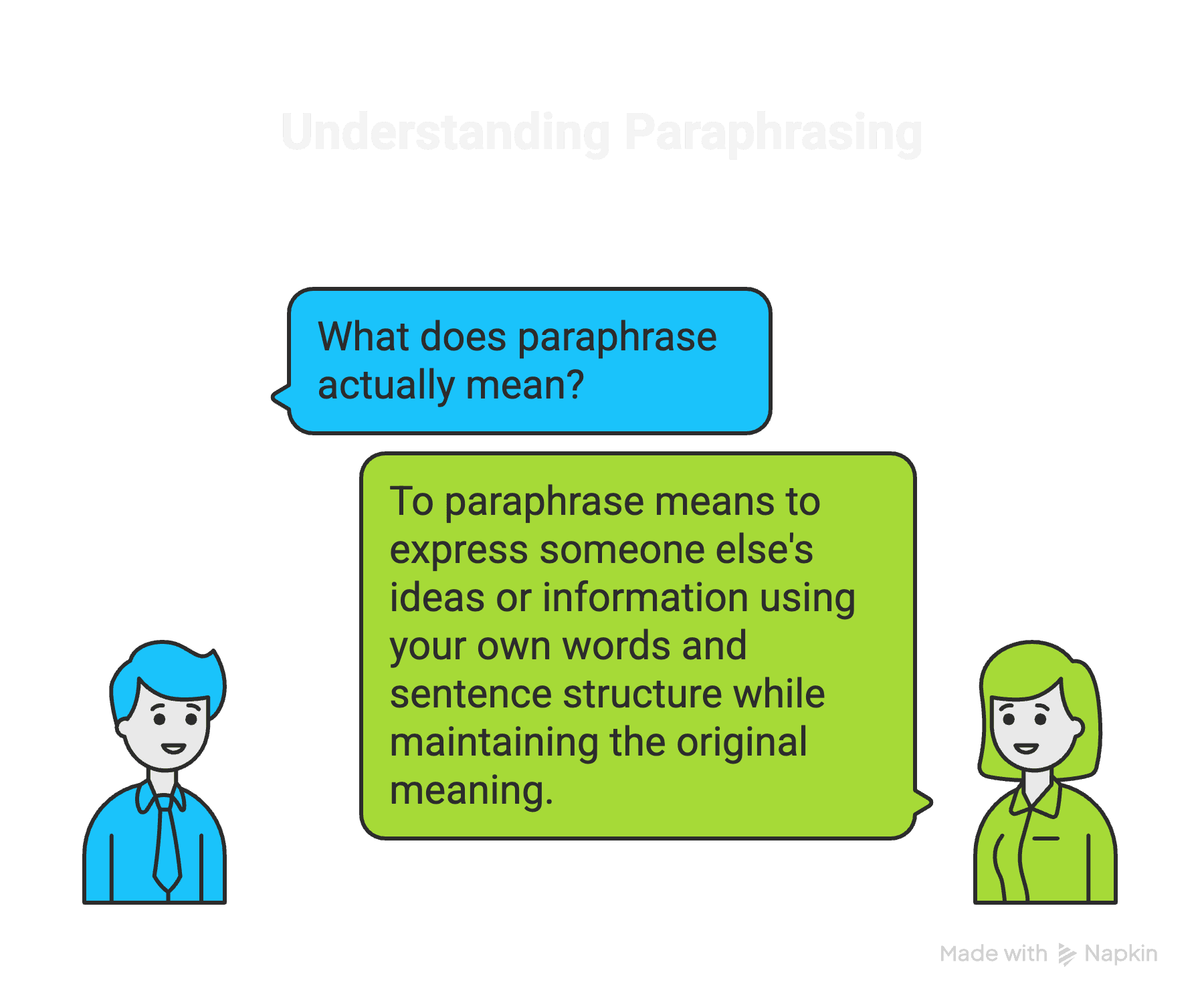
To paraphrase means to express someone else's ideas or information using your own words and sentence structure while maintaining the original meaning. It's not translation, it's not summarizing, and it's definitely not just changing every third word to its synonym.
Real paraphrasing involves:
- Complete restructuring of sentences and paragraphs
- Original word choices that fit your writing style
- Maintained meaning without losing the source's intent
- Proper attribution to the original author
- Your own voice coming through the rewritten content
Think of paraphrasing as taking someone's idea and explaining it the way you would naturally explain it to a friend—while being completely honest about where the idea came from.
The 5-Step Paraphrasing Method That Actually Works
Most paraphrasing advice tells you to "use different words." That's amateur hour. Here's the professional approach:
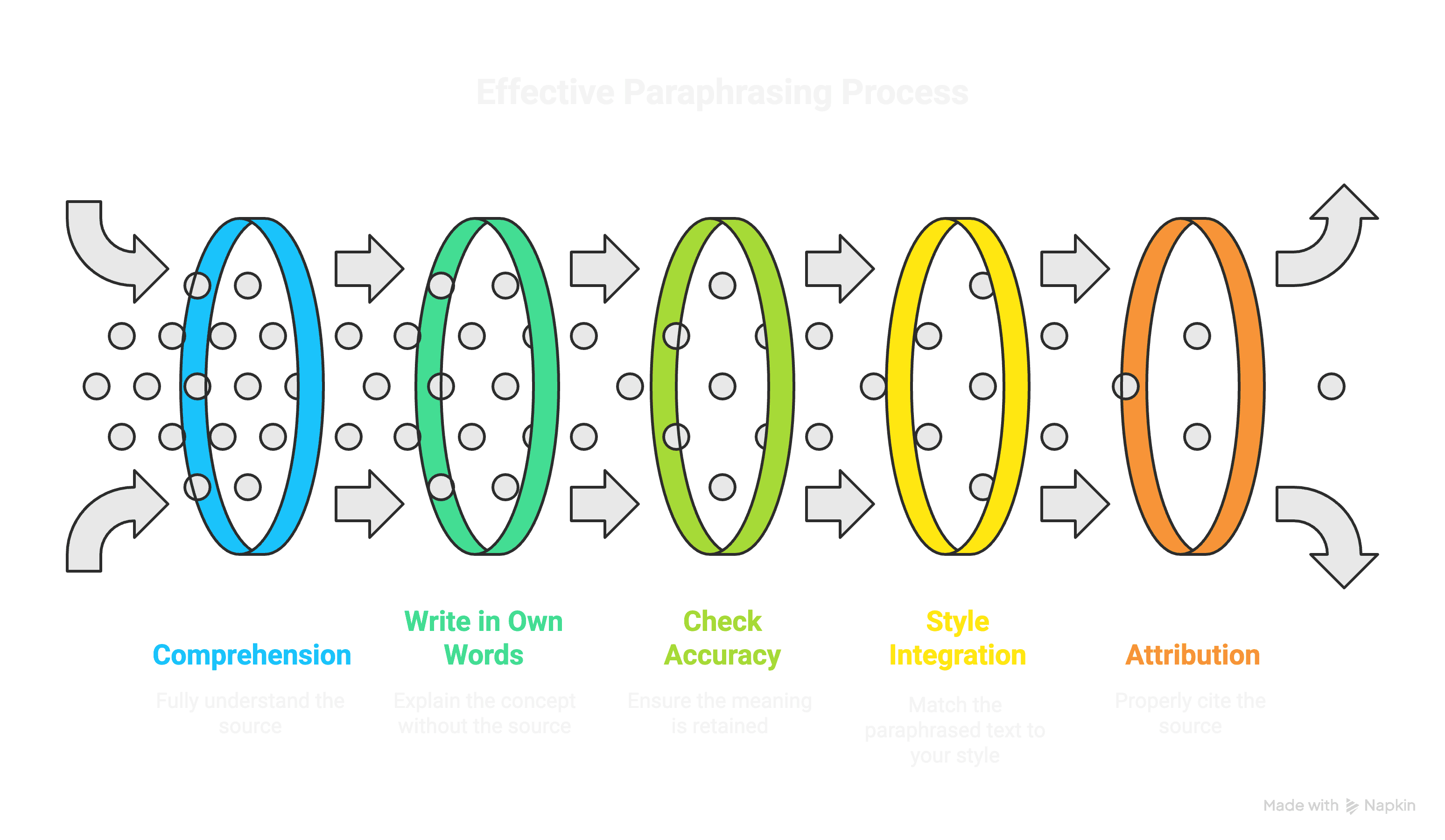
Step 1: Complete Comprehension First
Before you write a single word, make sure you fully understand the source material. Read it twice. Can you explain the concept without looking at the original? If not, keep reading until you can.
Step 2: Close the Source and Write
This is crucial: close the original document. Put it away. Now write out the concept in your own words as if you're explaining it to someone who's never heard of it before.
Step 3: Check for Accuracy
Open the source again. Does your version capture the same meaning? Did you miss any important nuances? Adjust accordingly, but don't start copying phrases.
Step 4: Style Integration
Make sure your paraphrased content matches your writing style. If you naturally write in short, punchy sentences, don't suddenly start using long, academic phrases just because that's how the source was written.
Step 5: Proper Attribution
Always cite your source. Paraphrasing without attribution is still plagiarism, even if you changed every single word.
Manual Paraphrasing vs Paraphrasing Tools: The Real Difference
With over 201,000 monthly searches for "paraphrasing tool," it's clear that many people are looking for automated solutions. But here's what most people don't understand about the difference between manual and automated paraphrasing:
Manual Paraphrasing Advantages:
- Maintains your voice and writing style
- Preserves context and nuanced meaning
- Allows for creative interpretation and insight
- Builds your writing skills over time
- Creates truly original content
Paraphrasing Tool Limitations:
- Robotic output that doesn't match your style
- Lost nuance in complex ideas
- Potential accuracy issues with technical content
- Obvious patterns that plagiarism checkers can spot
- No learning benefit for your writing development
When Tools Make Sense:
- Quick reference for alternative word choices
- Large volume content where perfection isn't critical
- Getting unstuck when you can't think of different phrasing
- First draft creation before manual refinement
The Academic Paraphrasing Challenge
Students face unique challenges when paraphrasing because academic writing has specific requirements that most paraphrasing advice ignores:
Academic Paraphrasing Must:
- Maintain scholarly tone while using your own voice
- Preserve technical accuracy in specialized subjects
- Follow citation standards specific to your field
- Demonstrate understanding rather than just word substitution
- Integrate smoothly with your argument or analysis
Common Academic Paraphrasing Mistakes:
- Patchwork paraphrasing - taking phrases from multiple sources and stitching them together
- Over-reliance on synonyms - changing words but keeping the exact sentence structure
- Lost meaning - focusing so much on changing words that the original point gets muddled
- Style inconsistency - paraphrased sections that obviously don't match your writing voice
- Inadequate citation - assuming that changing words means you don't need to cite
Advanced Paraphrasing Techniques for Different Content Types
Not all content should be paraphrased the same way. Here's how to adapt your approach:
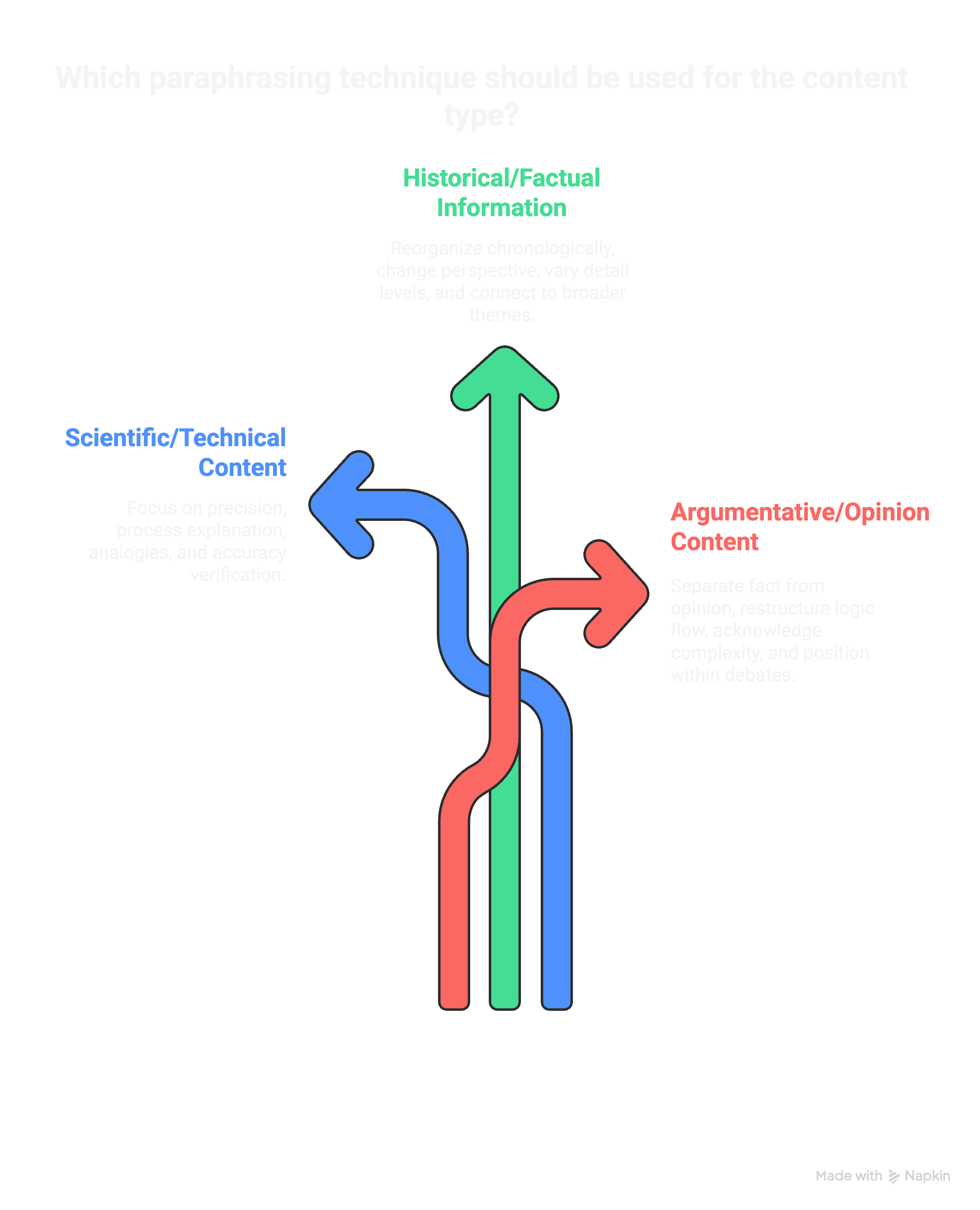
Scientific or Technical Content:
- Maintain precision - some technical terms can't be changed without losing meaning
- Focus on process explanation - describe how something works in your own logical flow
- Use analogies - explain complex concepts through familiar comparisons
- Verify accuracy - technical paraphrasing requires extra fact-checking
Historical or Factual Information:
- Reorganize chronologically - present events in different time sequences
- Change perspective - tell the same story from a different viewpoint
- Vary detail levels - zoom in on some aspects while summarizing others
- Connect to broader themes - link specific facts to larger patterns
Argumentative or Opinion Content:
- Separate fact from opinion - clearly distinguish what's objective vs. subjective
- Restructure logic flow - present the same argument in different logical order
- Acknowledge complexity - add nuance that the original might have missed
- Position within larger debates - show how this argument fits broader discussions
The Psychology of Effective Paraphrasing
Understanding why paraphrasing works (or doesn't) can make you dramatically better at it:
Cognitive Load Theory
Your brain can only process so much information at once. When you try to paraphrase while looking at the source, you're overloading your working memory. That's why the "close the source" method works—it forces deeper processing.
The Generation Effect
Information you generate yourself is remembered better than information you simply read. This is why good paraphrasing makes you understand content more deeply than just reading it.
Transfer Learning
When you paraphrase effectively, you're not just rewriting—you're transferring knowledge from one context to another. This builds connections that make the information more useful and memorable.
Paraphrasing in the AI Era: What's Changed
The rise of AI writing tools has completely changed the paraphrasing landscape. Here's what you need to know:
AI Detection and Paraphrasing:
Modern plagiarism checkers don't just look for copied text—they also flag content that shows patterns of automated paraphrasing. Simple word substitution is easier to detect than ever.
The Human Advantage:
- Contextual understanding that AI often misses
- Creative connections between ideas
- Personal voice that makes content engaging
- Ethical reasoning about when and how to paraphrase
Best Practices in 2025:
- Combine human insight with AI assistance when appropriate
- Focus on understanding over word-swapping
- Develop your natural writing voice
- Be transparent about your process
Common Paraphrasing Myths Debunked
Let's clear up some dangerous misconceptions:
Myth 1: "Changing Every Third Word Is Enough"
Reality: This creates awkward, unnatural text that's easy to detect and hard to read.
Myth 2: "Paraphrasing Means You Don't Need Citations"
Reality: You always need to cite paraphrased content. The ideas aren't yours, even if the words are.
Myth 3: "Longer Paraphrases Are Better"
Reality: Good paraphrasing can be shorter or longer than the original, depending on your purpose.
Myth 4: "Paraphrasing Tools Are Cheating"
Reality: Tools can be helpful aids, but they're not substitutes for understanding and skill.
Myth 5: "Perfect Paraphrasing Is Undetectable"
Reality: Good paraphrasing isn't about avoiding detection—it's about adding value while respecting sources.
Building Your Paraphrasing Skills: A Practice Framework
Like any skill, paraphrasing improves with deliberate practice:
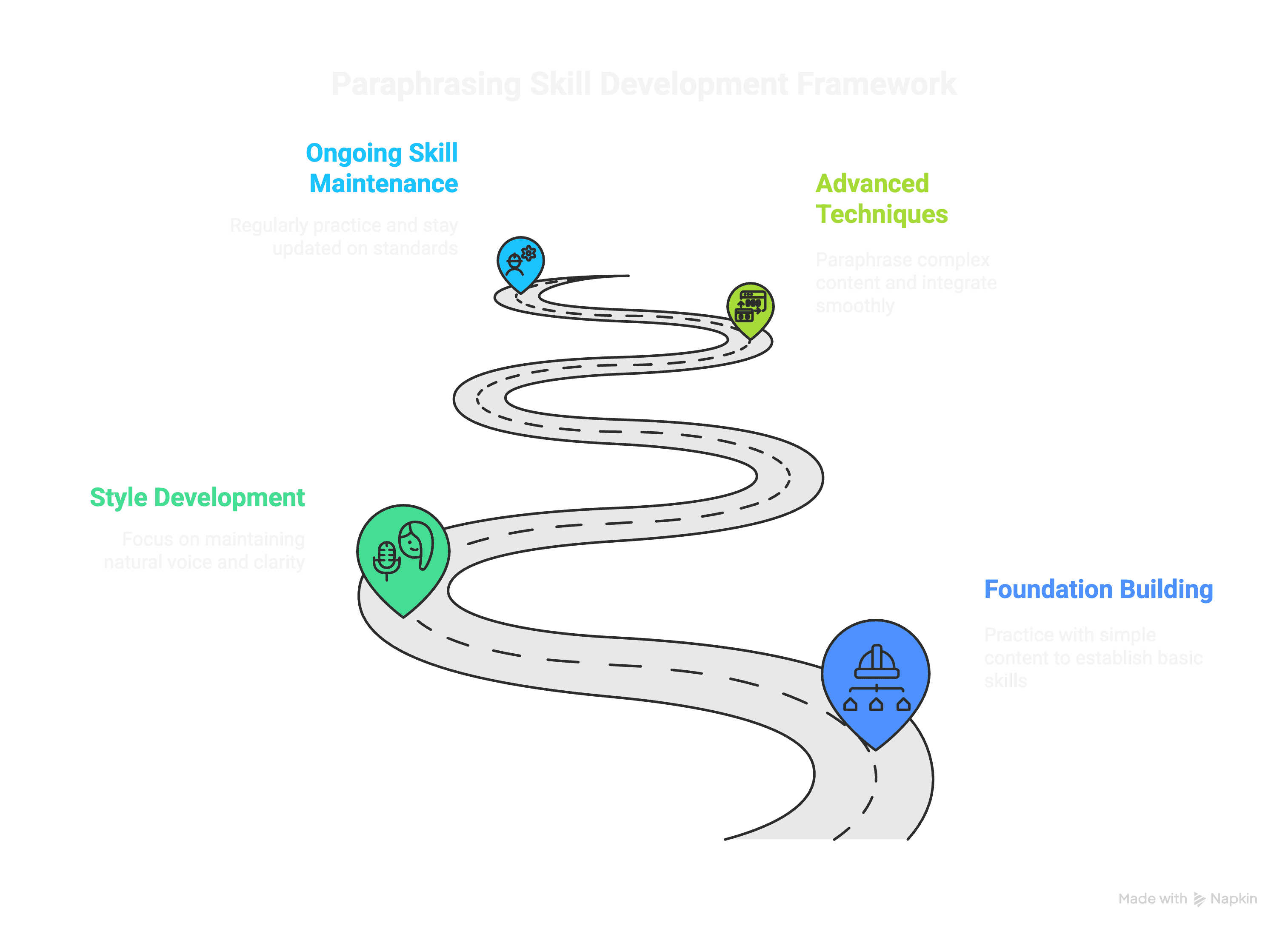
Week 1-2: Foundation Building
- Practice the 5-step method with simple, familiar content
- Focus on accuracy over elegance
- Compare your paraphrases with the originals for meaning preservation
Week 3-4: Style Development
- Work on maintaining your natural voice
- Practice with content from your field or interests
- Get feedback from others on clarity and flow
Week 5-6: Advanced Techniques
- Try paraphrasing complex, technical content
- Practice integrating paraphrases smoothly into your own writing
- Work on attribution and citation formatting
Ongoing: Skill Maintenance
- Regularly practice with challenging material
- Stay updated on citation standards in your field
- Develop a personal paraphrasing checklist
The Ethics of Paraphrasing: Beyond Plagiarism
Good paraphrasing isn't just about avoiding plagiarism—it's about intellectual honesty and adding value:
Ethical Paraphrasing:
- Adds insight or new perspective to existing ideas
- Properly attributes all source material
- Respects the original author's intent and contribution
- Serves your readers by making content more accessible or relevant
- Demonstrates understanding rather than just word manipulation
Red Flags:
- Paraphrasing to hide your sources
- Using paraphrasing to meet word counts without adding value
- Misrepresenting the original author's position
- Creating content that's harder to understand than the original
Troubleshooting Common Paraphrasing Problems
When paraphrasing goes wrong, here's how to fix it:
Problem: Your paraphrase sounds robotic
Solution: Read it aloud. If it doesn't sound like something you'd naturally say, start over with the "explain it to a friend" approach.
Problem: You keep using the same sentence structure as the original
Solution: Try writing your paraphrase as bullet points first, then convert to sentences using your natural style.
Problem: You're losing important details
Solution: Create a list of key points from the original, then write your paraphrase to include all of them in your own organization.
Problem: Your paraphrase is too similar to the original
Solution: Wait a day, then paraphrase from memory of the main concept rather than the specific text.
The Future of Paraphrasing: Trends and Predictions
As we move deeper into the AI era, paraphrasing skills are becoming more valuable, not less:
Emerging Trends:
- Hybrid approaches combining human insight with AI assistance
- Emphasis on voice and style as differentiators
- Integration with fact-checking and source verification
- Real-time collaboration between writers and sources
Skills That Will Matter:
- Deep comprehension over surface-level word changing
- Ethical reasoning about source use and attribution
- Style consistency across different types of content
- Critical evaluation of AI-generated paraphrases
Mastering Paraphrasing: Your Next Steps
Becoming truly skilled at paraphrasing takes time and practice, but the investment pays off in better writing, deeper understanding, and stronger academic or professional integrity.
Start with the 5-step method. Practice with content you genuinely find interesting. Focus on understanding first, elegant expression second. Always cite your sources. And remember—the goal isn't to hide where your ideas come from, but to present them in a way that serves your readers better.
The best paraphrasers don't just change words—they add value. They take complex ideas and make them clearer. They connect concepts in new ways. They respect their sources while developing their own voice.
That's the difference between word-swapping and real paraphrasing. And in a world where anyone can generate text instantly, that human touch of understanding and insight becomes more valuable than ever.
Ready to take your writing to the next level? Mastering paraphrasing is just the beginning of developing strong, ethical writing skills that will serve you throughout your academic and professional career.